You can watch a recording of the debate on the Te Korimako Facebook page.
Article in the Taranaki Daily News by Matt Rilkoff
It was posited as a debate, and it was a good one, but it was also an extended telling off for the only right wing candidate to take back to his party.
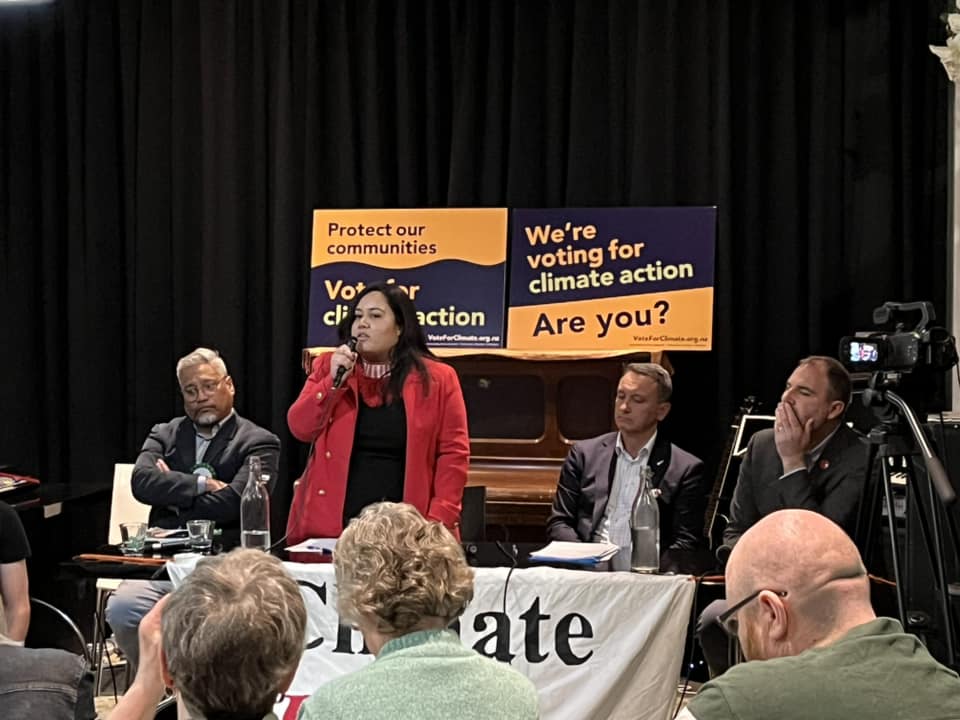
Not that Labour Party candidate Glen Bennett was let off the hook, it’s just that National’s David MacLeod took the brunt of the attendees’ frustration at Thursday night’s Taranaki Climate Debate 2023.
”I knew I was going to be the most controversial, but thank you for your polite conversation,” MacLeod said at the conclusion of the event in the cosy Green Door Cafe in New Plymouth.
He got a polite round of applause for that, but most reserved their enthusiasm for the Green Party’s self-described “interloper from Palmerston North” Teanau Tuiono and Bridget Bell, of Te Pāti Māori.
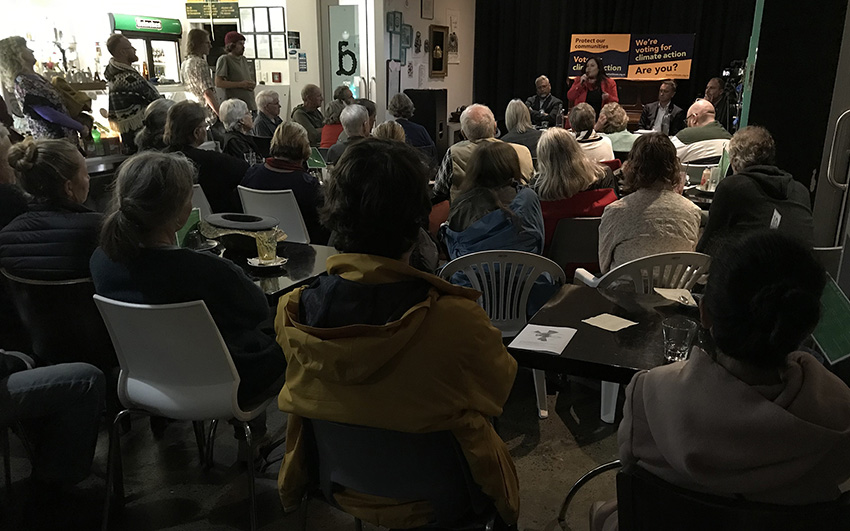
Though neither are standing for a Taranaki electorate, the pair of left-wing political candidates were the crowd favourites, mostly because they were the only ones preaching the message it appeared most of the 90 or so people in the room wanted to hear.
The debate wasn’t solely about climate change and the two main parties’ inadequate responses, it was also about social and political reform.
Terms that send shivers up any right-wing spine, such as degrowth, wealth tax, public transport, community action and co-governance, were bandied about with the relaxed abandon of those 100% secure in their beliefs.
It was a crowd built for Tuiono, who confidently demanded New Zealand join other wealthy countries and institute some form of tax on the rich.
More than once he claimed 311 New Zealand families controlled $85 billion, more money than the country’s poorest 2.5 million people.
“There are enough resources in this country. We just need to get organised,” he said.
It was Bell’s crowd too. Her party would always look after the land, she said, because when the land was healthy, the people were healthy too.
They would also lift the poor, and push for governance and constitutional transformation as a matter of “survival” for Maori.
Her biggest scoring point of the night was her admonishment of the National candidate for a reference he made to “Māori elite” in his party’s hesitancy to support co-governance at a public service level.
It was always going to be a thorny subject for MacLeod to tackle but debate organiser Urs Signer, of Climate Justice Taranaki, ran an intelligent and shamelessly confrontational debate that routinely forced candidates into tight corners.
MacLeod’s fear that co-governance could lead to “elite Māori” being appointed to boards because of their status rather than experience and skills would have probably gone down a treat with a right-leaning crowd, but not this one.
Bell’s response, when it came a few minutes later, was to castigate MacLeod, who is of Māori heritage himself.
“First of all, we are all elite,” she said to loud cheers, and then, to more cheering, she asked what people were afraid of when it came to co-governance.
“We won’t take anything from you, we will add value to you.”
It was a stinging moment for MacLeod, who at times looked like an injured doe in the midst of a pride of starving lions.
Bennett had a distinct advantage over his fellow New Plymouth electorate candidate in that his party had done a few things the left agreed with, and he had the trump card courtesy of their ban on offshore oil and gas exploration.
Though final speaker Tuhi-Ao Bailey expressed her disappointment that Labour had squandered its majority and, under Chris Hipkins, backtracked on so much, Bennett was quick to read the room, infusing his answers with personal views that hit the right chord but didn’t put him offside with party policy.
“It’s been 183 years of my way,” he said in reference to his support for co-governance, for example. “And how is that going for us?”
As Bennett surely knew, it was an event where rhetorical questions were going down a treat.
 Climate Justice Taranaki