Ka mihi atu tātou ki te whānau pani, te iwi pani, te motū pani e noho pouri ana ki te taha o Kingi Tūheitia Pōtatau Te Wherowhero VII.
We acknowledge Kingi Tūheitia for his years of service to his people and Te Kotahitanga, the desire to unite ngā iwi Māori to create peaceful resolution and justice for mana whenua and Tāngata Tiriti.
Kua hinga te totara. Moe mai rā e te Kingi ki tō maunga Taupiri.
Kia ora e hoa mā,
Spring has sprung! It is a beautiful time of the year, adorned by magnolia, plum, karo and kōwhai blossoms, enjoyed by a myriad of native birds – kererū, tauhou (silvereye) and tūī. Take time to appreciate them amid the busyness of daily lives and the crises we face in our hometown, in Aotearoa and beyond. They help soothe our minds and re-energise us.
Climate Strike, 27/09
The School Strike 4 Climate had enough of this government. We are mobilising with them to demand real climate action from the government at all levels.
Get in touch if you can help plan, support or participate on the day.
Stay tuned for detailed action on the day.
Palestine Solidarity Rally and Petition
Palestine is a human rights and climate justice issue.
Rally and March for a Free Palestine every Saturday 1pm at the Landing, Ngāmotu.
Sign the petition for New Plymouth District Council to call for a Permanent ceasefire and to align their procurement policy with UN resolution 2334 and the recent ICJ ruling to not contract with any companies associated with the building and maintenance of Israeli Illegal settlements. Petition is also available for signing at the rallies.
Remediation NZ to be shut down
This week, the Environment Court dismissed the appeal by Remediation NZ on the Taranaki Regional Council’s decision to refuse the renewal of resource consents for its composting and vermiculture operation at Uruti. This is a big win for Ngāti Mutunga and Uruti Community Parties composed of Taranaki Energy Watch, North Taranaki Awa Protection Society, and Urenui and Districts Health Group. The fight to stop Remediation NZ’s Uruti operation began in 2017 when the application for consent renewal was publicly notified. Over the years, the Uruti site had received over 20,000 tonnes of oil and gas waste to ‘remediate’, along with organic wastes like chicken carcass, paunch grass, green wastes and treated timber. The stockpiling and spreading of such wastes have degraded the waterways, contaminated the groundwater and affected the wellbeing of nearby neighbours. CJT did some early work, looking at the organic certification and of Revital products and traceability of materials derived from various Remediation NZ operations. It is a relief that the site is finally being shut down, but questions remain as to the fate of the stockpiled materials and how the site will be managed and remediated. The Environment Court decision is here.
Fast-track Approvals Bill toned down
Cabinet has agreed to recommend the some changes to the infamous Fast-Track Approvals Bill to the Environment Committee, such as final decisions on projects will not sit with Ministers but with the expert panel. The Community Against the Fast Track (CAFT), of which CJT is a member, is unimpressed by the tinkering with the Bill. The purpose of the Bill still says nothing about environment criteria. The Bill still fails to embed the constitutional obligation to honour Te Tiriti o Waitangi. The public is still largely excluded from the process. Projects that had been lost in courts like Trans Tasman Resources’ seabed mining application off South Taranaki are not excluded from fast track consideration. CAFT encourages all to take action against the Fast Track, by telling others about it, writing letters to editors, going on radio shows, putting up posters and talking to your MPs.
350 is keen to support community groups at risk of being affected by Fast Track projects in their local areas. Fill out their survey on how you would like to be supported.
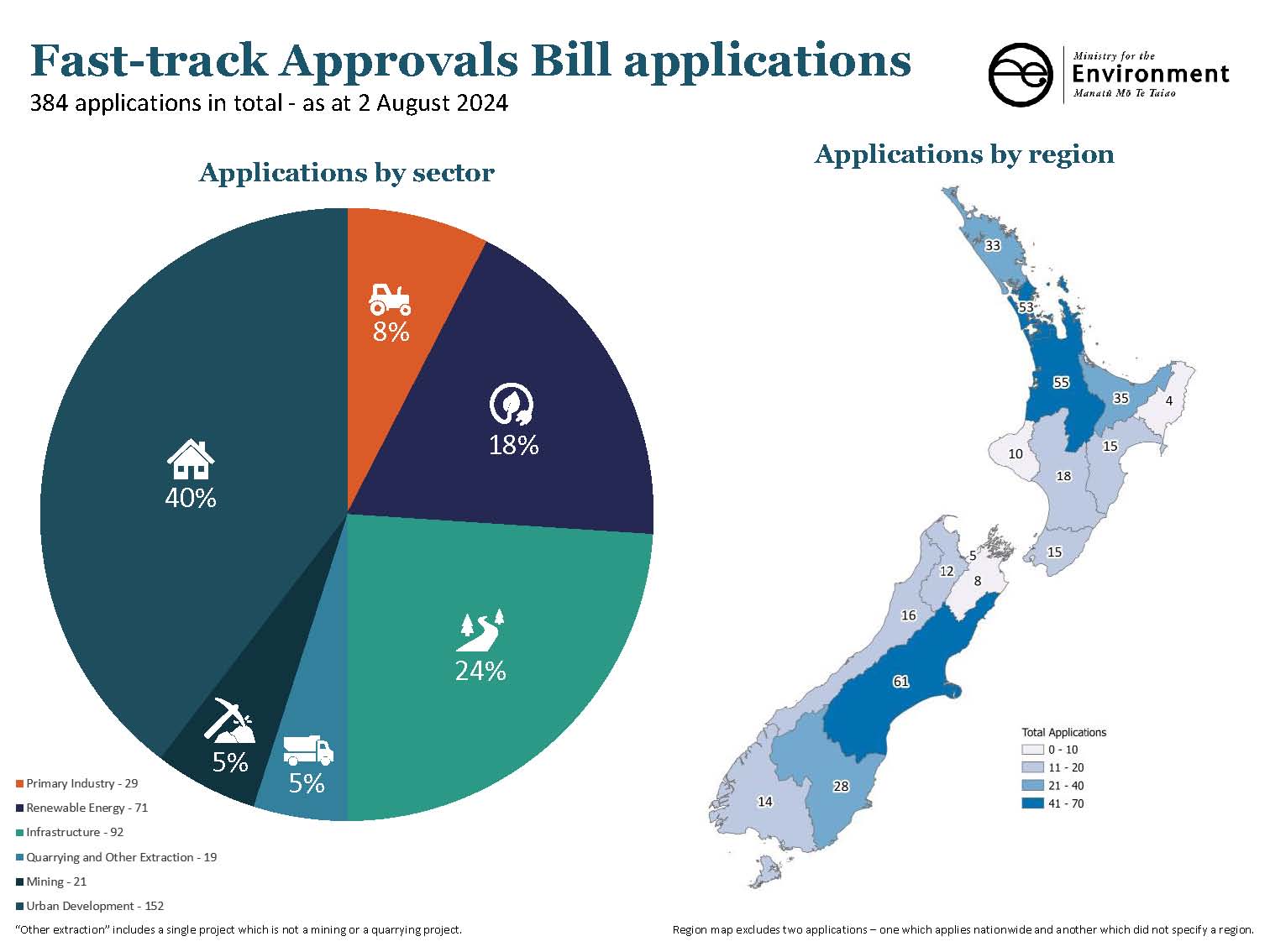
The government announcement also included a breakdown in types of the 384 projects that have applied to be listed.
Gas shortage, price gouging and energy crunch
The month of August saw nationwide panic over skyrocketed power prices allegedly resulted from a shortage of fossil gas, an unusually dry winter and low wind levels. The wholesale electricity prices over $800 a megawatt hour (MWh) threatened the viability of industries like sawmills and job security. At long last, the big power companies’ profiteering behaviour was put in the spotlight, including Associate Energy Minister Shane Jones’ calling the companies out as profiteering. Victoria University economist Geoff Bertram explained, “The market is doing exactly what it was set up to do, which is to get high prices and high profits at times of scarcity… The real pain from price gouging goes down on ordinary New Zealanders, not on the big companies.” The blame was not just on gentailers but Parliament which legislated this and “governments that over the years have systematically failed to fix it.”
Dr. Kevin Trenberth at Auckland University said, “The problem behind our insecure energy supply is the absence of a national cooperative approach to managing and distributing power to take advantage of this country’s natural resources… the centralisation of the many forms of sources of energy, solar, wind, hydro, maybe some thermal backup storage, is the way to reduce emissions as well as secure our energy supply.”
Contrary to the above advice, the prime minister pushed forward a raft of measures to supposedly tackle the energy security crisis:
- Reverse the ban on offshore oil and gas exploration
- Remove regulatory barriers to construct Liquefied Natural Gas (LNG) import facilities
- Allow electricity lines companies to own generation
- Allow ‘gentailers’ to access hydro contingency
- Improve electricity market regulation
A subsequent announcement to pass a law allowing the building of an LNG import terminal without going through the usual consenting, not even fast-track consenting, sparked widespread criticisms. Sustainable Energy Professor Ralph Sims warned, “… if we import LNG… including the whole process of extracting the gas, cleaning it, chilling it, transporting it, storing it, and utilizing it, it exceeds coal emissions per kilowatt hour.”
Not only is LNG import expensive and damaging to the climate, it is also extremely dangerous and unsuitable for places like Port Taranaki which is surrounded by an urban population. Such a threat is not new. Watch this poignant video from 16 years ago, courtesy of Taranaki Energy Watch, explaining the risks of building an LNG terminal in New Plymouth. The risks now would be much heightened with an increased population.
Offshore renewable energy regulatory regime
The Ministry for Business has released a design of an offshore renewable energy regulatory regime focussing on offshore wind. The purpose of the regime is to “give developers greater certainty to invest in offshore renewable energy projects, and enable the selection of developments that best meet New Zealand’s national interests.” There is no mention of sustainable development, and as the Environment Defence Society says, it “ignores environmental risks”. The selection of areas for development will be developer-led. The first feasibility permit round is expected to be open in late 2025. A feasibility permit will give the holder the exclusive right to apply for a commercial permit covered by the feasibility permit. Public consultation is only required for feasibility permitting. Once the regulatory regime is in force, offshore renewable energy projects will be eligible under a revised Fast-Track Approvals process.
We seriously question the role of offshore wind energy development without a holistic energy assessment and strategy for Aotearoa. The relevant Cabinet paper acknowledged that, “The role of offshore wind in our future energy mix is unclear… It is unclear, however, if or when offshore wind will become an economic option for New Zealand and therefore when developments will happen. The lifetime cost of offshore wind generation is currently significantly higher than onshore wind or solar.” The economics of offshore wind will rely heavily on hydrogen export. The industry admits that government support will be required to “derisk projects and secure finance.”
Just transition
What we really need is a just transition to an ‘economy of enough’ enabled by energy conservation, sufficiency and equity while supporting more jobs that are socially and ecologically beneficial. Communities and workers need to take charge of this transition rather than leaving it to profit-driven industries and the government. We made a start by preparing Toitū Taranaki 2030. We would love some help and inputs into updating it and making it more user-friendly. Get in touch if you are interested.
Second Emissions Reduction Plan (ERP2) slammed
Our researcher Catherine described the government’s ERP2 in an opinion piece: “Governments, industries and just about everyone else says we need more energy to grow the economy. The coalition Government says let’s double the wind turbines and solar farms, make sure we keep fossil gas flowing, just capture the carbon and pump it into the ground, never mind who’s liable when it leaks. Agriculture is good for the economy, so let’s keep the cows, invest in a methane vaccine and other techno-fixes. Plant more pine trees to suck up some carbon and if nothing works, just pay a far-flung country to offset our incompetence.”
Read our full submission here. Submissions from the Parliamentary Commissioner for the Environment and the Environmental Defence Society are good reading also.
Kia kaha, kia manawanui.
 Climate Justice Taranaki