Year 2019 has been a super busy and exciting year here in Taranaki, Aotearoa. Here we share with you some highlights of the year.
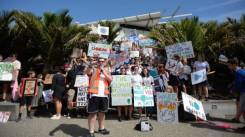
The year really kicked off in March with tens of thousands of students took part in the global School Strike 4 Climate. In Taranaki, a fossil fuel and industrial dairy stronghold, some two hundred students gathered in New Plymouth, demanding climate action. The surprise appearance of Prime Minister Jacinda Ardern was sensational for the young activists, even though few realised that the PM was on the way to launch the Taranaki Hydrogen Roadmap. The campaign culminated in September when 170,000 students and adults demonstrated across the nation, 40,000 in Wellington alone and hundreds in New Plymouth. The strikers brought climate justice issues to the front, gave solidarity to indigenous communities who are most affected, and demanded systemic change.

The New Zealand government has been responding, with the new Zero Carbon Act and a string of related legislative amendments (e.g. Resource Management, ETS…) and consultation documents (e.g. Resource Strategy, Vision for Hydrogen) which we commented on. Fourteen local councils have declared a ‘Climate Emergency’. Our New Plymouth District Council, on the other hand, opted for ‘Climate Urgency’ at its last meeting of the year. Under pressure from active citizens, youth and three new, young Councillors, NPDC also voted for the ‘advanced’ level of climate action proposed in its new ‘Climate Action Framework’.

But there is no ban on new coal mines, no moratorium on fracking and no halt to EPA issuing new oil drilling and discharge consents at sea. The EPA hearings on OMV’s applications to discharge ‘a cupful of’ harmful contaminants resulting from their planned drilling in the Great South Basin were ludicrous. Just as EPA granted OMV their consents to exploratory drill and discharge into the Taranaki Basin in January, OMV was given what they needed for the GSB in December, all applications non-notified.
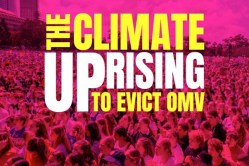
Unless OMV somehow sees sense and voluntarily surrenders their leases, there will be few options left to stop the ‘oil mining villain’, other than perhaps more non-violent protest action. In that spirit, we joined Greenpeace, Extinction Rebellion and heaps of supportive locals in a three day blockade at OMV’s New Plymouth office. The action was a success, judging by head of OMV NZ Gabriel Selischi’s comments afterwards, “I don’t see myself being able to continue to operate as today, and commit large amounts of money if this disruption will become more systematic.”
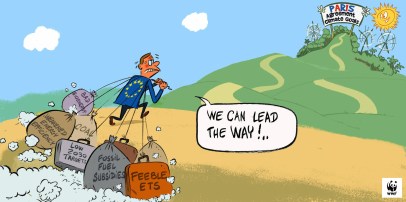
Meanwhile, the NZ government continues to rely on false economics and the rejigging of the Emissions Trading Scheme (ETS) to supposedly curb emissions. Yet the ETS is a joke, with exemptions for 90% of emissions from ‘emissions intensive and trade exposed’ industries such as steel, aluminium, methanol, cement and urea production through the allocation of free NZ Units. Similarly 95% of agricultural emissions would be exempt as proposed in the Emissions Trading Reform Amendment Bill which is open for public submission till 17 Jan 2020.
 Alarmingly, methane emissions from ammonia-urea fertilizer plants in the US have been shown to be 100 times greater than previously reported. We didn’t know that when we padlocked Ravensdown’s gate in September.
“So this is a warning to Ravensdown, Ballance and the industrial farming sector that the spotlight is on them now. The world is calling for urgent change towards sustainable and regenerative farming which can convert productive pastures to a net carbon sink. If these companies don’t change, they should expect to lose their social licence and investors just like their buddies in the oil and gas sector. We need an urgent just transition that works for everyone and an end to CEOs lining their pockets with the collective wealth of stripping our environment, workers and communities,” our founding member Emily Bailey explained why we did it. The numbers of clicks (over 20,000) and hate posts following this minor disruption was phenomenal. We must have pinched a major nerve of the capitalist central nervous system!
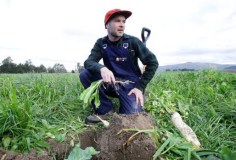
Ironically, industrial agriculture, while being one of the ‘villains’ at the moment, has potential to become one of the ‘saviours’, because of the huge carbon storing capacity of healthy soil. “If every acre of farmland were returned to a soil carbon level of just 3%, one trillion tons of carbon dioxide would be removed from the atmosphere and stored in the soil… The size of the potential solution is equivalent to the size of the problem,” said David Perry.

A growing number of NZ farmers are already committed to regenerative farming which captures carbon in the soil, improves water quality, increases biodiversity, integrates food production with forestry, minimises imported feeds and urea fertiliser, and rebuilds smaller, family run farms that are resilientand empower communities. A step up in commitment and support will enable farmers to transition to this regenerative way of farming.
Indeed, ‘just transition’ was the buzz words of the year here in Taranaki, along with ‘hydrogen’, ‘green urea’ and ‘roadmap’, etc.
 At the start of the year, a few of our members and many others took part in a series of Just Transition workshops organised jointly by MBIE and Venture Taranaki. A few of us also attended the Just Transition Summit in April where the Draft Taranaki 2050 Roadmap was released. Sadly, these government initiatives are nowhere near fast or strong enough. The processes lack Māori and wider community inputs and are overly
  business and technologically driven.
Notably, hydrogen (brown, blue or green) and carbon capture and storage (CCS) are more like a smoke screen than a solution.
 To ensure our transition to a low emission, sustainable and resilient society is effective and socially just, we need community-led and transformative change. So in June, we organised our own Just Transition Community Conference featuring 16 speakers and panelists, and attended by nearly 100 people.
 Building on what was learnt, we hosted a Community Strategy Hui in November where we began drafting a 2030 Just Transition Community Strategy. If you’re keen to offer your thoughts and expertise in transport, housing, energy, landuse, education, Māori and sharing economy, or other important areas for such a strategy, let us know. We would love your inputs.
 Climate Justice Taranaki
Reblogged this on The Most Revolutionary Act and commented:
Meanwhile, the NZ government continues to rely on false economics and the rejigging of the Emissions Trading Scheme (ETS) to supposedly curb emissions. Yet the ETS is a joke, with exemptions for 90% of emissions from ‘emissions intensive and trade exposed’ industries such as steel, aluminium, methanol, cement and urea production through the allocation of free NZ Units. Similarly 95% of agricultural emissions would be exempt as proposed in the Emissions Trading Reform Amendment Bill which is open for public submission till 17 Jan 2020.