Kia ora e hoa mā,
Kicking off the month, we had over 30 participants in our webinar Why LNG is a Bad Idea, jointly co-hosted with Taranaki Energy Watch and Community Energy Taranaki. We thank our speakers from Sustainable Energy Forum, Lawyers for Climate Action, Taranaki Energy Watch and Rewiring Aotearoa for sharing with us their invaluable knowledge on the government’s plan to build a Liquified Natural Gas (LNG) import facility in Taranaki. We also thank our participants who asked lots of questions, leading to some lively discussions. If you missed the webinar or would like to watch it again, here is the recording:
Passcode: k!3E%@nL (officially started at 3:50’)
Since the webinar, Lawyers for Climate Action and the New Zealand Climate Foundation filed a complaint with the Ombudsman, challenging the Ministry of Business, Innovation and Employment (MBIE)’s decision to withhold critical conclusions from the modelling underpinning the government’s decision to proceed with the $2.7 billion facility, to be funded by a levy on every NZ electricity consumer. Clearly it is of public interest to see the full evidence base for this decision. What is this government hiding?
Ocean as Climate Ally vs the Fisheries Amendment Bill
The ocean generates 50% of the oxygen we need, absorbs 30% of all carbon dioxide emissions and captures 90% of the excess heat generated by these emissions. As such, the UN describes the ocean as “the world’s greatest ally against climate change”. Yet the ocean is under threat, so does its capacity as our climate ally. Notably, bottom trawling destroys habitats (see documentary Ocean with David Attehborough), kills indiscriminately and releases large amounts of carbon otherwise stored in the seabed.
The NZ government has put forward a Fisheries Amendment Bill which, if passed into law, would further weaken the ability of regulators to responsibly manage fisheries and restore damaged marine ecosystems. Fishing corporations would be able to continue and likely increase exploitation of marine ecosystems, including highly sensitive habitats, using destructive fishing methods such as bottom trawling. By locking up camera footage onboard fishing vessels and limiting the duration for judicial review to within 20 days, the Bill would severely reduce the opportunity for public scrutiny. The Ombudsman warns that this would breach the Bill of Rights.
CJT encourages all to submit on this Bill using the Parliament portal, no later than Wednesday the 6th May. For more information, read the submission guide from the Environmental Law Initiative and CJT’s submission.
From Climate Education to Freskival
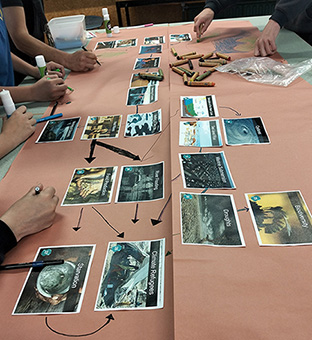
It has been a busy and energising time for the CJT education team with the Climate Fresk project underway.
So far we have had the privilege of working with a group from Why Ora, the WITT Conservation and Pest Management students and members of the public who signed up for our Ora Taiao, Ora Tangata | Thriving Planet, Thriving People fresk workshops at the Waitara Library, the Hāwera Library and at the Toi Foundation rooms in Ngāmotu | New Plymouth.
Furthermore, five of our trained facilitators visited Puniho Pā at the invitation of Vincent Nuku and Kathleen Winiata for their weekend wānanga attended by over thirty people. We were nervous hearing the acronym ‘AI’ initially but were delighted to hear that for them AI means: “Ancestral Intelligence”! It was a humbling experience to be able to run a Fresk workshop with the whānau there. After the initial card game, during facilitated discussions, Ahi Kaa quickly identified familiar themes of colonization, confiscation and extractive land use; and spoke of the commitments they have to their mokopuna in whatever time they still have, to mitigate and adapt to whatever may be coming.
The workshops on April 18th coincided with the national ‘Freskival’: the first-ever nationwide Climate Fresk activation, where people across Aotearoa gathered at over 15 fresks to understand and discuss how to take action on climate change: to reduce emissions ourselves, in our communities and at a systemic level.
In addition to adult Fresk workshops, it was a pleasure for Lisa our Education Officer to bring a junior Fresk to an Ōpunake High School enviro-sci class. A junior fresk is a 2 hour workshop suitable for Year 8+ groups. This workshop is a good introduction or consolidation of what climate change is and a springboard for projects at home and in the school / community.
If you like the sound of the above, get in touch or REGISTER here for our upcoming workshops:
9th May Saturday (9:30am – 12:30pm) – HĀWERA LIBRARY
12th May Tuesday (5:30pm-8:30pm) – BUTLER’S REEF, OĀKURA
14th May Thursday (5:30-8:30pm) – SINCLAIR EVENTS CENTRE, ŌPUNAKĒ
15th May Friday (9:30am – 12:30pm) – INGLEWOOD LIBRARY
21st May, Thursday (5:30pm – 8:30pm) – New Plymouth
Public Meeting on the LNG import facility, Tue 26th May 6-7:30pm
This in person public meeting at St. Mary’s Peace Hall (44 Vivian St. Ngāmotu | New Plymouth) will further raise awareness about the government’s plan to build an LNG import facility in Taranaki. Importing LNG will lock us into volatile global energy pricing which will impact on electricity pricing. It is contrary to NZ’s international climate obligations by prolonging our reliance on fossil fuels and ignoring alternative solutions to the dry year problem. These must all be considered if we are to achieve long-term sustainability, control and security of our energy future. Yet the government wants to rush through an Enabling Liquefied Natural Gas Bill and have contracts signed by mid-year.
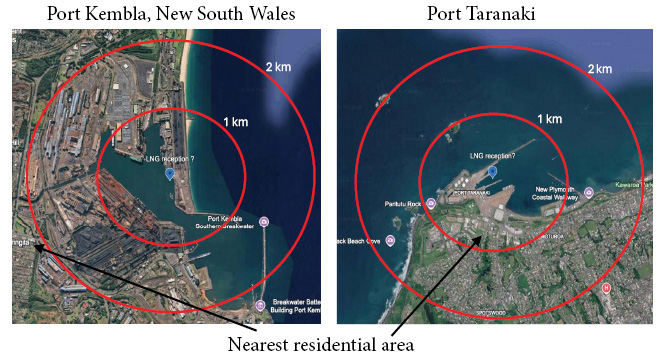
Crucially, if the facility is to be located at Port Taranaki, understanding the risks and consequences from accidents, including fatalities, and injuries of nearby communities are crucial. At Port Kembla Energy Terminal, the worst-case scenarios of a flash fire extend to nearly 2 km and toxic odorant effects from 89 metres (See maps below, courtesy of Sarah Roberts). Could such impacts and risks be adequately assessed under ‘Enabling’ legislation passed under urgency? What information would be made public? Will we have a say?
If you are concerned about the proposed LNG facility, come along to our public meeting.
Door will be open from 5:30pm if you’d like a cuppa and some snack before the meeting starts.
Electrifying the Titanic
If you missed the webinar by Mike Joy on the 8th April, we strongly recommend that you watch the recording. Below is from Our Climate Declaration:
“Electrifying the Titanic is a useful analogy to understand the limitations of the ‘electrify everything” proposed solution to humankind’s dilemma.
Of all the presumed so called ‘solutions to our climate crisis’ this rallying cry is central to the ‘net-zero’ call – no need for real change, just carry on as we are but with electric stuff rather than fossil powered, net-zero 2050, no worries.
But the reality is the climate crisis is far from our only existential threat.
Electrifying New Zealand would not in any way mitigate all the other existential crises we face here and globally, in fact it would exacerbate most of them, because they are all (just like climate change) driven by overshoot.
Electrification of everything would increase the extraction, processing and transportation of materials especially critical minerals (NZ is 15th worst in world per capita) requiring even more fossil fuel use and much more harm.
The reduction in consumption required in the wealthy world may be seen as radical – but also necessary to meet biophysical limits. This will not be convenient, but we must realise that how we in the wealthy world live is radical.“
Mike’s slides may be requested from Our Climate Declaration.
Fuel, Physics and What Comes Next
This was a superb webinar presented by Nathan Surendran, a transition engineer and Chair of the Wise Response Society who has been writing extensively about the current energy crisis and its implications. Here’s the intro:
“NZ will probably hit its climate targets. Not because of good policy, but because the economy is being forced into contraction by an energy crisis that mainstream institutions didn’t see coming – or chose not to. Nathan Surendran connects the immediate fuel emergency to the biophysical economics that conventional policy ignores: declining energy returns, thermodynamic constraints on transition, and a coming wave of insolvency and default that may cause more damage than fuel shortages themselves. He presents practical tools for community resilience, from mutual aid frameworks to fair rationing mechanisms, and argues that the response must start at the community level because government is not going to lead it.”
If you missed the webinar, watch the recording here. Read some of the relevant resources on Nelson Tasman Climate Forum, notably No Fuel Still Fedwhich suggests what we can do this week to be prepared:
- Get seed
- Build or borrow a tunnel house
- Store food
- Talk to our neighbours
- Contact our councillors
Well, there are lots of food for thoughts in this pānui.
We know many readers are very active in the community, doing good. Indeed, this is where true power, resilience and joy come from – working together and sharing what we have, be it food, skills, muscles, time or simply a smile…
Kia māmā, kia hauora, kia kaha,
Nā,
Climate Justice Taranaki

